|
The plains along the Yom river and the slopes the hills, Khao Phra Si, Khao
Yai, Khao Suwankhiri and Khao Phahnom Phloeng, are strategic locations and quite
fertile.These characteristics might explain why this area has been continuosly occupied since early times.
Archaeological Evidence of Pre-Sukhothai Settlements
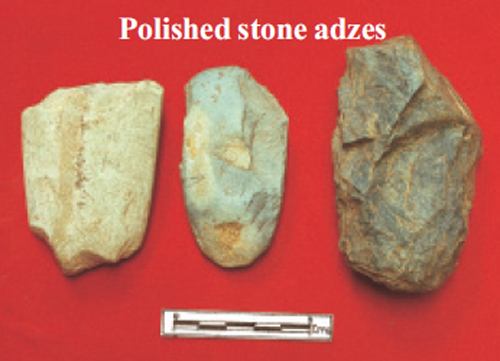
The existence of early settlements in the Yom river valley is suggested by
the discoveries of polished stone adzes at Ban Tha Chai and Si Satchanalai town in
Si Satchanalai District, Sukhothai Province. Polished stone adzes were also found
at Khao Khen and Khao Ga, about 15 kilometres from Si Satchanalai. Since stone adzes have normally appeared in prehistoric
settlements in Thailand, this is indirect indication of prehistoric, probably Neolithic, settlements in the Yom river valley.
Thai and Chinese historic documents, dated to the 11th century, mention an ancient city
in the area belonging to Sukhothai. This city is mentioned in the “Yonok Chronicle” of Northern Thailand as
“Chalieng”, and in the chronicle of the Chinese Sung Dynasty it is khown as “Choeng Lieng”.
|
|
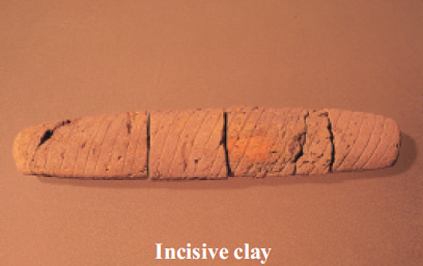
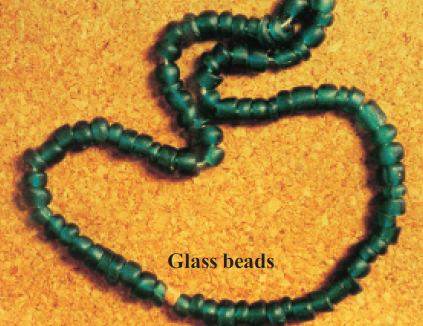
Archaeological excavations conducted during 1993-1994 at Wat Phra Si
Ratana Mahathat, Wat Chom Chuen and Wat Chao Chan in historic Si Satchanalai
town also turned up evidence indicating the existence of pre-Sukhothai activities
and buildings in the areas around these temples. Initial human occupation in these
excavated areas is now suggested to date to around the 3rd century A.D. Archaeological
evidence of the next habitation period here includes 15 burial sites dated to
the 5th - 6th century. In the deposits overlying the burials are remains of at least 2
large brick buildings which may date to the 10th-11th century. The next archaeological
deposits, immediately below the most upper strata of the Sukhothai period,
yield traces of brick buildings and ceramic roof tiles with designs of the Bayon art
style of the ancient Khmer. The art style of these objects is comparable to that of
parts of Wat Phra Si Ratana Mahathat Chalieng, which date to the 12th century A.D. |
Si Satchanalai during Sukhothai Period
 |
According to early stone inscriptions, local legends, and historic chronicles,
2 large cities existed in the Yom river valley before King Si Indrathit became the
ruler of Sukhothai. These cities were called Sukhothai and Chalieng, or Si
Satchanalai. A Thai king named Pho Khun Si Nao Nam Thom ruled Sukhothai-Si Satchanalai. When he passed away, a Khmer
leader ruled Sukhothai and Si Satchanalai until later, when Pho Khun Pha Muang, a son of Pho Khun Si Nao Nam Thom,
cooperated with Pho Khun Bang Klang Hao to defeat the Khmer and regain the two cities. Pho Khun Bang Klang Hao was
enthroned as the new king of Sukhothai named Pho Khun Si Inthrathit.
King Si Inthrathit sent his eldest son, Pho Khun Ban Muang, to govern the town of Si Satchanalai. When Pho Khun Ban Muang became King of the Sukhothai
Kingdom, he sent his younger brother, Pho Si Satchanalai Historical Park Khun Ramkhamhaeng, to rule Si Satchanalai.
The status of Si Satchanalai then changed from an autonomous city into a principality
governed exclusively by the crown prince of the Sukhothai Kingdom.
Pho Khun Ramkhamhaeng became the king of Sukhothai after his elder
brother passed away. During the reign of King Ramkhamhaeng, Sukhothai
experienced great economic, cultural, and social development. The ceramic
industry prospered. He also had Buddha relics unearthed in order to pay homage
before reburying then and building a chedi with a boundary wall over the relics in the middle of Si Satchanalai town.
When King Lue Thai ruled Sukhothai, Phaya Li Thai was the crown
prince ruling Si Satchanalai. In 1347, Phaya Li Thai regained the throne of Sukhothai
after it had been occupied by a ruler who seized it from the King of the Phra Ruang dynasty.
King Li Thai was a great ruler and scholar. Evidence indicates that he
wrote a book called “Trai Phum Phra Ruang”, the book of life and former lives
according to Buddhist concepts, while he ruled Si Satchanalai. After he ascended
the throne at Sukhothai, he was ordained as a monk. Because of his exemplary
activities and behavior, he was named Phra Maha Dharmaraja.
During the time of King Li Thai, who ruled Si Satchanalai before ascending
the throne at Sukhothai, many temples were built and restored at Si Satchanalai.
Later, when Sukhothai fell under the power of the Ayutthaya Kingdom, Si
Satchanalai still maintained its status as an important town, governed only by
a member of the former Sukhothai royal family. However, when King Trailokanat
governed Ayutthaya, the status of Si Satchanalai changed to that of a secondary outpost.
|
Si Satchanalai (Sawankhalok) during Ayutthaya Period
The Sukhothai Kingdom fell under the rule of the Suwannaphum dynasty
of Ayutthaya after King Li Thai passed away, around 1370-1371. This is unclear
However, the state of occupation was likely to be the relationship between the
relatives, especially the dynasty that ruled the important towns such as Sukhothai
and Si Satchanalai. Towns of a lesser status which refused the rule of Ayutthaya,
such as Song Khawae (Phitsanulok) and Cha Kang Rao (Kamphaeng Phet), were subdued.
There was no evidence of protest against the rule of Ayutthaya in Si
Satchanalai called Sawankhalok by Ayutthaya. This might be because this town
was the first Sukhothai area town that accepted the rule of Ayutthaya. In the early
period of Ayutthaya’s control, Si Satchanalai possibly retained their own rulers.
During the reign of King Borom Trailokanat, Sukhothai had already been
annexed by Ayutthaya. In the same period, King Tilokarat of Lanna occupied
Phrae and Nan. Thus, the boundary of Lanna was adjacent to Si Satchanalai, the
northern outpost of Ayutthaya. King Tilokarat seized the towns that were formerly
controlled by Ayutthaya, including Si Satchanalai. King Borom Trailokanat
resided at Song Khwae and constructed a new town named Phitsanulok in an
area of the former town, Song Khwae. The prolonged battle between King Borom
Trailokanat and King Tilokarat began, and finally, King Borom Trailokanat was able to recapture those towns.
Si Satchanalai, or Sawankhalok, was an important producer of glazed
ceramics, called Sangkhalok wares for Ayutthaya. The products were exported
to overseas countries such as the Philippines, Japan, Indonesia, etc. Later, after
Ayutthaya had improved the administration of the Kingdom, Sawankhalok became
a secondary outpost with a ruler appointed by Ayutthaya..
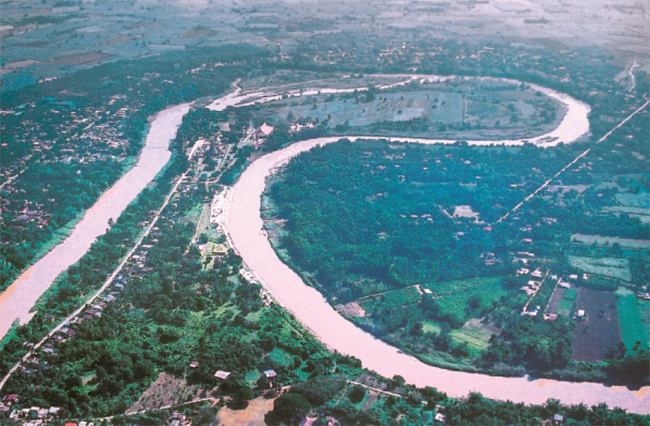
When Ayutthaya was defeated by the Burmese in 1767, the towns under
the rule of the Ayutthaya kingdom were abandoned. When the land became peaceful
again, Sawankhalok was re-established and moved to Tha Chai village, south of
the former location. The town was then moved to Wang Mai Khon village in the
early Rattanakosin period. Today, Sawankhalok district is located on the bank of
the Yom river, opposite Wang Mai Khon village. The name Si Satchanalai was
used for the district where Si Satchanalai ancient town is located.
Religious and Cultural Significance of Si Satchanalai
While known as Chalieng, this town one of the cultural centres in the
Yom river valley. When it came under the rule of Sukhothai, and was called Si
Satchanalai instead of Chalieng, it remained a town of high status. It was the
residence of the crown prince. Most of the kings of the Sukhothai kingdom had
been rules of Si Satchanalai before accending to the royal throne in Sukhothai town.
Architectural and archaeological remains found in this historic town clearly
indicate that it was not only a politically important town, but also an important
religious of centre. The importance of the town was applarent long before the
town was included in the Sukhothai kingdom.
During the Sukhothai period the Lankavamsa sect of Hinayana Buddhism
was widely practiced. However, religious buildings belonging to Bhramanism and
Mahayana Buddhism have also been found at Wat Chao Chan and Wat Phra Si
Ratanamahathat Chalieng. This supports the theory that Si Satchanalai had diverse religious practices since early times.
A large number of religious buildings and temples
in Si Satchanalai were constructed from laterite, which is found locally. These
religious structures were normally coated and decorated with stucco.
The decorative stucco sculptures of Si Satchanalai are considered highly artistic
achievements of the ancient Thai people.
Technological and Economic Development of Si Satchanalai
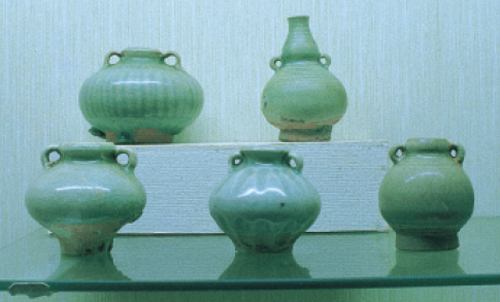
The ceramic industry of the town was well known since the time when it
was known as Chalieng. During the Sukhothai period, glazed ceramics production
at Si Satchanalai developed into the largest glazed ceramic industry in Southeast
Asia. The products were exported to neighbouring countries, as well as to countries across the seas.
Iron working and bronze casting were other technologies practiced in
Si Satchanalai. Iron weapons, tools and implements, as well as bronze objects
found here, attest to these technological developments.
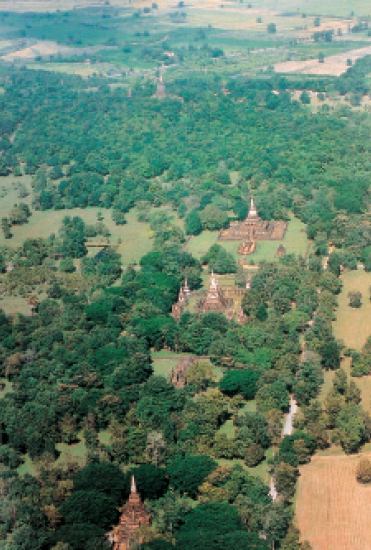
Si Satchanalai Historical Park
The area registered as Si Satchanalai Historical Park covers 3 subdistricts
: Tambom Sarajit, Tambon Nong Or, and Tambon Tha Chai, of Si Satchanalai
District, Sukhothai Province. The total area of the park is about 45.14 square
kilometres. There are 215 historic buildings in this historical park. However, the
historic town of Si Satchanalai is located in the village of Ban Phra Prang, Tambon
Si Satchanalai, about 550 kilometres to the north of
Bangkok..
|
Historic Monuments inside the City Wall |
| Lak Muang (Town Post) |
| Wat Chang Lom |
| Wat Chedi Chet Thaeo |
| Wat Khao Phanom Phloeng |
| Wat Khao Suwankhiri |
| Wat Nang Phaya |
| Wat Suan Kaeo Utthayan Noi |
| Wat Suan Kaeo Utthayan yai |
| Wat Udom Pa Sak |
|
Historic Building Number BN.11 |
| The Historic Building Number BN.11 |
| The Royal Palace |
| Gate and Fortress |
| Si Satchanalai City Walls |
|
Historic Monuments to the East of the City |
| Wat Suan Sak |
| Wat Pa Kaeo or Wat Tri Phum Pa Kaeo |
|
Historic Monuments to the West of the City |
| Ancient Irrigation Dike |
| Wat Chedi Ain |
| Wat Chedi Chet Yot |
| Wat E Pur |
| Wat Hua Khon |
| Wat Khao Yai Bon |
| Wat Khao Yai Lang |
| Wat Phaya Dam |
| Wat Phrom Si Na |
| Wat Rahu |
| Wat Rang TT.4 |
| Wat Rang TT.5 |
| Wat Sa Khai Nam |
| Wat Sa Pathum |
| Wat Yai Ta |
|
Historic Monuments to the South of the City |
| The Town Wall of Chalieng |
| Wat Chao Chan |
| Wat Chom Chuen |
| Wat Khok Singkharam |
| Wat Noi |
| Wat Noi Cham Pi |
| Wat Phra Si Ratanamahathat |
|
Historic Monuments on Top of Hills |
| Wat Khao Indra |
| Wat Khao Kaeo |
| Wat Khao Phra Bat |
| Wat Khao Phra Si |
| Wat Khao Rang Raeng |
|
Amphoe Muang |
| Phra Mae Ya Shrine |
|
Amphoe Sawankhalok |
| Sawankha Woranayok National Museum |
|
Amphoe Si Satchanalai |
| Ruin of Old Celadon Factory (Thuriang Kiln) |
| Celadon Kiln Site Study |
| Si Satchanalai National Park |
| Si Satchanalai Ordination Celebration |
|
Amphoe Khiri Mat |
| The Ramkhamhaeng National Park (Khao Luang) |
|
|
|