|
This temple is located on the bank of the Yom river and is about 400 metres east of Wat Phra Si Ratanamahathat.
The important Sukhothai period buildings that can be seen in this temple include a main chedi of
Sri Lankan style, a vihara, and a mandapa, all of laterite. Inside the main chedi are the remnants of
a square building. This led Professor Jean Boisselier to suggest that the main chedi had been transformed from an earlier Khmer shrine.
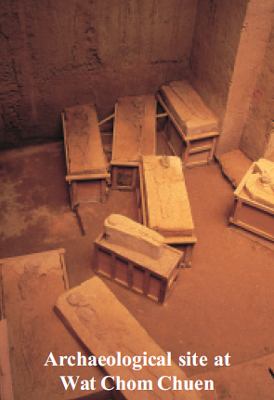
Archaeological excavations have also yielded much evidence that Wat Chom Chuen was initially
constructed in a pre-Sukhothai period. 15 human skeletons excavated at a depth of about 7-8 metres
suggest that the area around this temple was first occupied during the 3rd - 4th
century AD. Human habitation of this area continued up to at least the 6th - 7th
century. Around the 11th century, 2 groups of large brick buildings appeared in this
area. Finally, a Sukhothai period temple was built there.
|