The region is located on the peninsula between the Andaman Sea of the Indian Ocean to the West and the South China Sea of the Pacific Ocean to the East. It was the land of fertility both natural resources and cultures as well as center of region on commercial-economic aspects. Fascinated it was for Andaman
including various islands liked PhuKet, Tarutao and Ardang with the white clean seashore curved along the shape of land. Sea National Park, Samui island, Samila beach, Naratas beach together with wide area of Songkhla lake and Tinnasulanond bridge linked the land with the well-known Khoa Yor, all were referred for its beauty by tourists both Thais and foreigners.
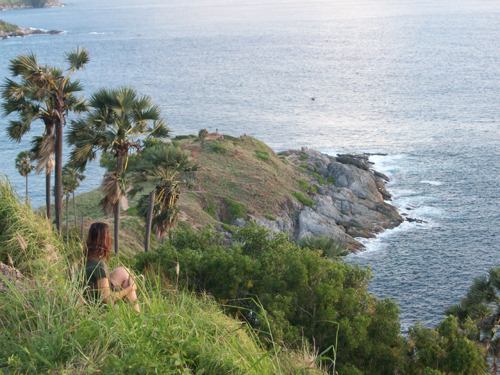
Phromthep Cape, Andaman Sea.
Southern region has a richly varied topography, including basin areas for cultivation of paddy and vegatables, wild jungles, mountains, beaches, seaside resorts, waterfalls, caves, parks, lakes and many islands of all sizes, offering spectacular scenery throughout.
Important mountain ranges of the south are the Tanao Si Range, the Nakhon Si Thammarat Range and the San Kala Khiri Range.
It is drained by several important rivers, including the Phum Duang River (Khirirat River), the Tapi, the Pattani, the Tha Thong, the Takua Pa, the Pak Panang and the Trang Rivers.
Area
It occupies an area of approiately 70,715.2 square kilometres. The largest province is Surat Thani (12,891.5 sq. kms.) : the smallest is Phuket (543 sq. kms.) and all provinces but Yala and Phatthalung are bordered at some point by the sea.
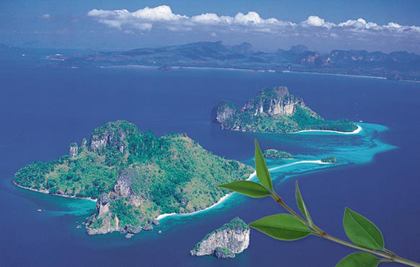
Mu Ko Phi Phi National Park, Krabi Province
Culture, Tradition and Folk Entertainment
The south has a rich and varied cultural tradition, with many festivals..
Chak Phra Festival which falls on the first day of the waning moon in the eleventh luar month. The one at Surat Thani is the largest among the others.
Sat Duan Sip Festival (Festival of the Tenth Lunar Month) or, as it is called by the residents of Nakhon Si Thammarat, Chumphon, Raong "Rap-Song Ta-Yai" which is celebrated to honour one's grandparents. The festival takes place on 14th - 15th day of the waning moon in the tenth lunar month.
The Boat Floating Festival, held on the full moon night of the sixth and eleventh lunar months to ward off bad luck and ensure bountiful catches.
The celebration of Goddess Lim Ko Nieo (Pattani) which takes place on the 15th day of the waning moon in the third lunar month.
Hari Rayo Fair which celebrates the end of a period of religious fasting and abstinence in the ninth mouth og each year.
Rong Ngeng is a form of folk dance of Thai Muslims. It is characterised by graceful postures and movements of feet, hands and bodies and pretty attire of men and women.
Mayong is the art of ancient folk dance of Thai Muslims.
Sila is a martial art fought with bare hands, stressing graceful postures and movements.
Nora refers to a form of dance typical of the south and consists of accompaniment of singing and music.
Phleng Bok is a kind of lullabies of the south.
Bull Fighting can be seen in Hat Yai in the first weekend and second weekend of the month.
Shadow Play (Nang Talung) is a performing art particularly popular anong the people in the southern part of Thailand.
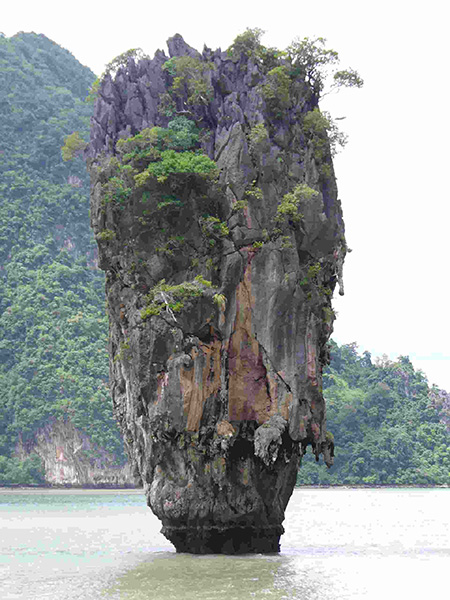
Ko Tapu, Phang Nga Bay, from : https://en.wikipedia.org/wiki/Phang_Nga_Bay
Local Foods
Some local specialities are Budu sauce, southern rice noodles, yellow curry, preserved fish kidney curry and Ko Lae Chicken
Local Handicrafts
- Mother-of-pearl ornaments from Ranong and Phuket.
- Shell, corals, and stuffed king lobsters from Phuket.
- Pha Yok (a special design hand woven fabric), Yan Liphao wickerware, banana trunk rope products, rattan ware, silverware, and lacquerware from Nakhon Si Thammarat
- Phumriang fabric from Amphoe Chaiya, Surat Thani.
- Ban Na Mun Si had woven fabric in the area of Amphoe Muang, Trang.
- Lamchiak (a kind of water plam) mats at Ban Khlong Mak, Amphoe Muang, Krabi.
- Krachut (a kind of straw) mats in Amphoe Khuan Khanun, Phatthalung.
- Hand woven fabric at Ko Yo, Songkhla.
- Shrimp chips, dried shrimp, and dried fish from Sougkhla, Narathiwat, Yala, and Pattani.
- Rong Rien Specy rambutan from Ban Na San, Surat Thani.
- Som Chuk (a kind of orange) at Amphoe Na Thawi, Songkhla.
- Coffee products from Trang, Satun and Chumphon.
- Pearl farming at Amphoe Ko Yao, Phangnga; Ko Payam, Ranong; Ko Nakha, Ko Rang, Ko Bon, Laem Panwa, Phuket
A tip for travelers to the southern islands of Phuket, Phi Phi and Phang Nga is to take a bus or train.
Buses leave from the South/Southeast Bus Terminal, located in Thonburi (across the Chao Phraya River). Airconditioned and non-airconditioned buses leave every hour between 6 am and 10 pm. The journey takes between 10 and 12 hours at a cost, for the air-con bus.
The southbound train to Surat Thani leaves from either Hua Lamphong or Thonburi Stations nearly every hour between 6 am and 10 pm. After the 11-hour train ride, travelers must go into Surat Thani township to take a bus for the additional 150-kilometer trip to Phuket.
Southern Thailand consists of 14 provinces (Changwats) :