LOCATION:
[MY HOME]
[FUTURE]
[MY OFFICE]
[MY KING]
[MEMORIAL]
Trooping of the Colours, December 3 Bangkok

|
LONG LIVE HIS MAJESTY THE KING.
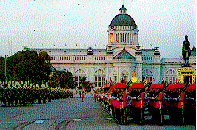
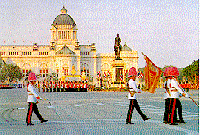
- There Majesties the King and Queen preside over this impressive annual event, held in the
Royal Plaza near the equestrian statue of King Chulalongkorn. Dressed in colourful uniforms,
amid much pomp and ceremony, members of the elite Royal Guards swear allegiance to the King
and march past members of the Royal Family.
|
|
-
"I SHALL GIVE MY LIFE FOR THE COUNTRY'S FREEDOM AND COMMOND CAUSE.
I SHALL UPHOLD THE SANCTITY OF THE CONSTITUTION OF THE THAI KINGDOM.
I SHALL BEHAVE IN ACCORDANCE WITH THE MORALITY OF THE RELIGION.
I SHALL MAINTAIN AND KEEP ALOFT THE GREAT HONOR OF THE MONARCH.
I SHALL OBEY MY SUPERIORS AND DISCHARGE MY DUTIES TO THE BEST OF MY ABILITY,
AND SHALL BE JUST AND FAIR TO MY SUBORDINATES.
I SHALL NEVER BREACH MILITARY SECRETS.
|
This oath is repeated in unison on December 3 of each year, at the Trooping of the Colours
that starts the celebration of His Majesties the King's birthday.
The day is known in Thai as "Ratcha Wanlop", when the Royal Guards renew their
allegiance to the King Attended by Their Majesties the King and Queen and members of the Royal
Family, the solemn ceremony is held at the Royal Plaza.
Since its inception at the beginning of the Fifth Reign, the Royal Guard Regiment has consisted
of men loyal to the Throne and hand-picked to defend the King and members of the Royal Family.
The Regiment, set up by King Mongkut (Rama IV), evolved from a 12-member squad of select
royal pages, comprising the young sons of noblemen close to the King, who were trained in modem
cavalry techniques. King Chulalongkorn (Rama V) later doubled the number of men in the unit. Called
"Two Dozen Officers," their function was to guard the king and accompany him on his trips.
In 1871, the the Directorate of the Royal Guards was created. The name "Ratcha Wanlop", with
its own royal insignia, was conferred on the Directorate, which was commanded by King Chulalongkorn himself.
The revolutionization of the armed forces in the Fifth Reign resulted in the creation of the
Ministry of Defence, which replaced the Department of Defence, or Krom Yutthanathikan, established
in 1887. Various components of the Royal Guard Directorate were transferred to the new setup, and
with only the infantry unit remaining, the Directorate was renamed Royal Guard Infantry Unit. In 1907
it became the Royal Guard Regiment, with then Crown Prince Maha Vajiravudh, later King Rama VI,
as its commanding officer.
When King Chulalongkorn died, King Vajiravudh, reaalizing the close ties that existed between
his late father and the Royal Guard Regiment, added "in the service of His Majesty King Chulalongkorn"
to the Regiment's name, with King Chulalongkorn's initials worn as an epaulette.
Following the political changes brought about by the revolution of June 24, 1932, the Royal
Guard Regiment was reduced to a battation. When King Ananda Mahidol (Rama VIII) ascended the
Throne, his younger brother, Prince Bhumibol Adulyadej, became the commanding officer of the Regiment.
The Royal Guard Infantry Regiment was revived with a forceof four battaloins in the present
reign. /in 1983 it became the Royal Guard Regiment, or Ratcha Wanlop, yet again, with His Royal
Highness Crown Prince Maha Vajiralongkorn as commander.
Units, battalions and regiments who have excelled in the armed forces has been named to the
Regiment, which presently has 51 establishments carrying its insignia.
The annual solemn oath-laking ceremony was initiated in 1880 during the reign of King Chulalongkorn.
The new commander of the Regiment, Chaophraya Surasak Montri, instituted the oath-laking ceremony
of the Royal Guards, with the King himself presiding over the event.
The tradition had been kept alive, and His Majesty King Bhumibol Adulyadej, a well known music
compose, even composed a march specially for the Trooping of the Colours. Wearing their specific
uniforms and colors, and marching to the tune of the Ratcha Wanlop March, the Royal Guards
march in precision before the King and Queen at the Royal Plaza.
Full of pomp and pageantry, the Trooping of the Colours has a deep meaning beyond the
layman's perception. It signifies the bond between the monarch and his subjects which has been
made stronger by events in the long history of nation. As the Royal Guards in their full regalia march
before the King, with the equestrain statue of King Chulalongkorn commanding the scene, the deep
love and respect in their eyes as they look up at the Monarch in the reviewing stand speak for all
Thais who regard their King and the Royal Family highly.
Ceremony of Taking the Oath of Allegiance and The Ceremonial Parade of the Royal Guards, 2 December 2005
Making of a Monach, the Bangkok Post
Amporn Samosorn, A Colorful Show of Devotion, King Bhumibol the Great "See The Highlights of the Royal obligation, P.73-80
Return to the Top