|
| ||
|
In the central region of Thailand, the Chao Phraya River is regarded as the bloodline of the Thai people. It has its origins in four rivers flowing from the northern region of the country. The four tributaries, namely the Ping, Wang, Yom and Nan, meet at Pak Nam Pho in the Muang District of Nakhon Sawan Province. The Chao Phraya River is 370 kilometers long.
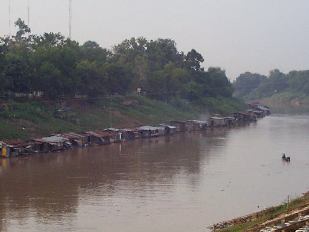 The Nan River, one of four tributaries of the Chao Phraya River, at Phitsanulok
Nevertheless, the long route from the Ping watershed in Chiang Mai to the Chao Phraya River and on through Samut Prakan Province to the Gulf of Thailand
remains vital to Thai life. It passes through 1,085 kilometers of Thai rural and urban countryside. It carries with it the history and culture of our country.
| ||
|
| 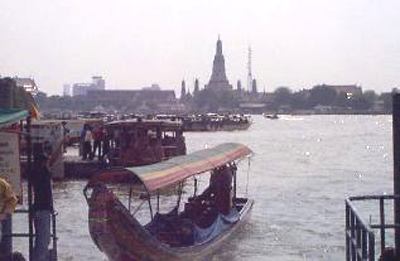 Veiw from Tha Chang landing and Wat Arun is located on middle
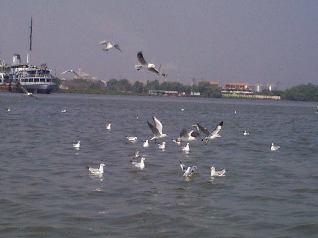 Bevy of Gulls in the Chao Phraya River between Amphoe muang Samut Prakan and Pra Samut Chedi
The Chao Phraya River basin covers most of modern central and northern Thailand and is bordered to the west by rugged Burmese mountains, to the north
by lofty mountains separating southern China from the Southeast Asian mainland, and to the east by the high, sprawling plateau settled by the Ban Chiang people.
A natural, self-contained geopolitical unit, this river basin was destined to play a central role in Thailand's development, becoming historically and agriculturally as important to the Thais as the Nile is to the Egyptians.
Later, it would become the Thai hertland and contain future Thai capitals and for centuries remain the major means of transport and communications. Eventually, it would be transformed into and intricately terraced,
irrigated rice bowl figuring among the most fertile areas on earth.
The influx of immigrants into the area took hundreds of year. They came in successive waves, each moving slowly along paradisical river valleys content to settle rather than move on. Those following moved past them
to hew out homes and fields from virgin forest. Traveling in compact groups, under separate chieftains, escaping famine, despotism or misfortune, all sought a degree of autonomy and shared a comman desire for a better, independent life.
| Chao Phraya Express Boat Route |
Click to view in larger map
|